

Read the backstory: Chapter 1.4: Voices of the Wind. Adventure on a Tower Under Construction >
Viktor Stahl. Episode 3: The Heartforge Guitar.
When the melody remembers.
Sometimes an instrument appears not when you take up a blueprint, but when a space first begins to sound within you. Heartforge did not begin in the workshop. It began on the day we first entered the Temple of “Holy Steel.”
Back then, I wasn’t looking for a new guitar—I had the Demon, a faithful, vicious, engineering-perfect instrument born of the wind on the steel beams of a skyscraper. We went to the mountains seeking acoustics. But the Temple turned out not to be a place where sound is found; it was a place where sound found you.
The Weight of Silence.
The first thing I felt inside the Hall of Thunder was weight. Not physical weight, but acoustical. The silence there was not a void. It pressed upon the chest as if the air had become denser, and every breath required effort. It felt as if the walls were listening to you before you could even hear your own footsteps.
As we moved through the hall, the sound of our steps returned not as an echo, but as a delayed reflection, as if the space first took it in, tasted it, and only then decided whether to give it back. I touched the wall and felt the cold of the granite. This cold was not dead. It resonated with a vibration that could not be heard with ears but could be read with the pads of one’s fingers. Stone conducted sound deeper than air. It was then that the strange sensation first appeared—that sound could have mass. That it was capable of pressing, holding, and even guiding thoughts.
Later, when we began to play and encountered the “Arc” and the phantoms, the hall ceased to be architecture. It became a participant. Every note returned altered. Heavier. Deeper. As if it had passed through someone else’s memory before returning to us.
The Demon handled the attack, but it was too fast for this place. It sliced the air, but here, the air needed to be pushed. I caught myself playing differently. Slower. Harder. I stopped trying to fill the space with sound and began allowing the space to fill the sound.
The Birth of a Concept.
After that trip, I struggled for a long time to formulate exactly what had changed. But the primary feeling remained—sound must have a heart. Not metaphorically. Physically. It must be born from a center that holds energy and releases it in measured doses, like the strike of a blacksmith’s hammer.
The new instrument should not copy what was heard but preserve it. It must hold the vibration longer than usual. Not release it immediately into the air. Give it time to form within the body. I found myself thinking more and more that sound should be born from the center of the instrument just as it had then—from the depths of the hall, where it was impossible to tell where the stone ended and the resonance began.
The idea for the visual form came from the memory of the fresco on the Temple column. A half-erased image of a winged creature holding a human heart in its claws. At that time, I did not yet guess what it might mean. Thus the image of Heartforge arose. A seven-string monster. A guitar that looks not like a musical instrument, but like a fragment of that very Gothic Cathedral on the mountain peak.
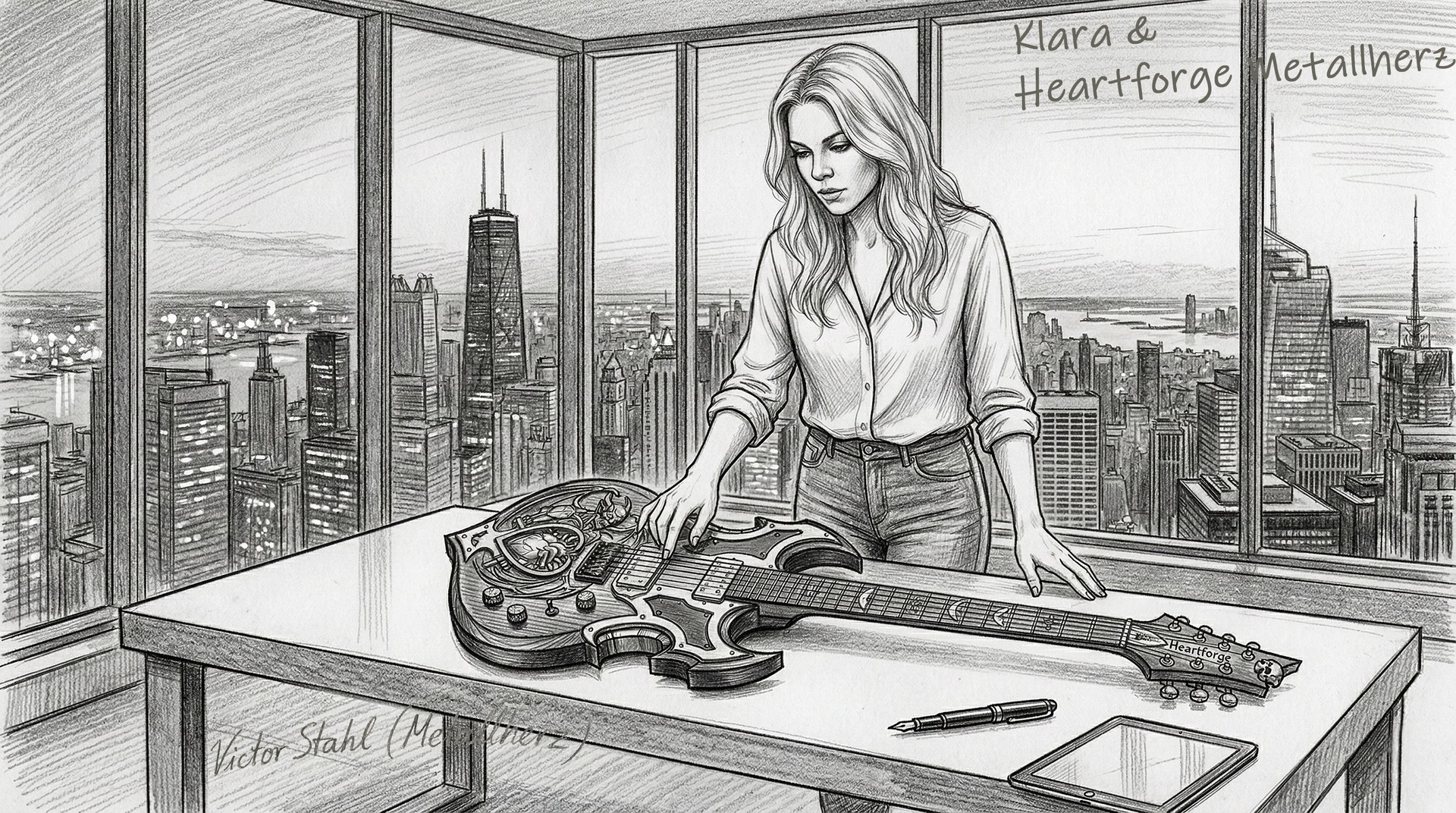
Clara’s Visit.
The office door opened almost soundlessly. Clara entered to look at the new prototype. She brought a thin folder of sketches—I recognized it immediately by the stiff cover stained with graphite and traces of soldering paste. She was going to work. Usually, she chose the far table by the window—a place where the light fell evenly and didn’t create glares on the metal.
The test sample of the guitar lay on the table. Approaching, she did not touch the instrument. She only tilted her head—slightly to the side, as if listening to an invisible frequency.
— “There is too much intention in it, ” she said after a pause, assessing the design. “It doesn’t want to be just beautiful. It wants to be convincing.”
I smiled. That was more precise than any technical description. Then she ran her fingers along the brass plate. Not as a musician—as a jeweler checking the balance of mass.
— “It doesn’t trust hands yet, ” Clara added. “It only trusts the construction.”
She said it calmly, without judgment—as a fact. Then she nodded to herself as if she had reached a decision and went to the table by the window. She laid out her sketches, took out a magnifying glass and tools, and soon the familiar sound appeared in the office—the quiet metallic rustle with which she always accompanied her work.
Clara’s presence was not a distraction. On the contrary, it gathered the space together. I looked at the Demon hanging on the wall—sharp, predatory, fast. And then I turned my gaze back to Heartforge. Some forms are born of precise aerodynamic calculation. Others—of the necessity to hold weight. There were still many checks ahead: geometry and electronics, mechanics and acoustics. But taking it in my hands to judge the balance, I knew—this was my guitar.
(from the notes of Viktor Stahl)
Read the Heartforge Metallherz Custom Guitar Technical Guide >