

Heartforge Metallherz: when an instrument becomes a weapon, a symbol, and the heart of a band all at once.
Technical Specifications — Heartforge.
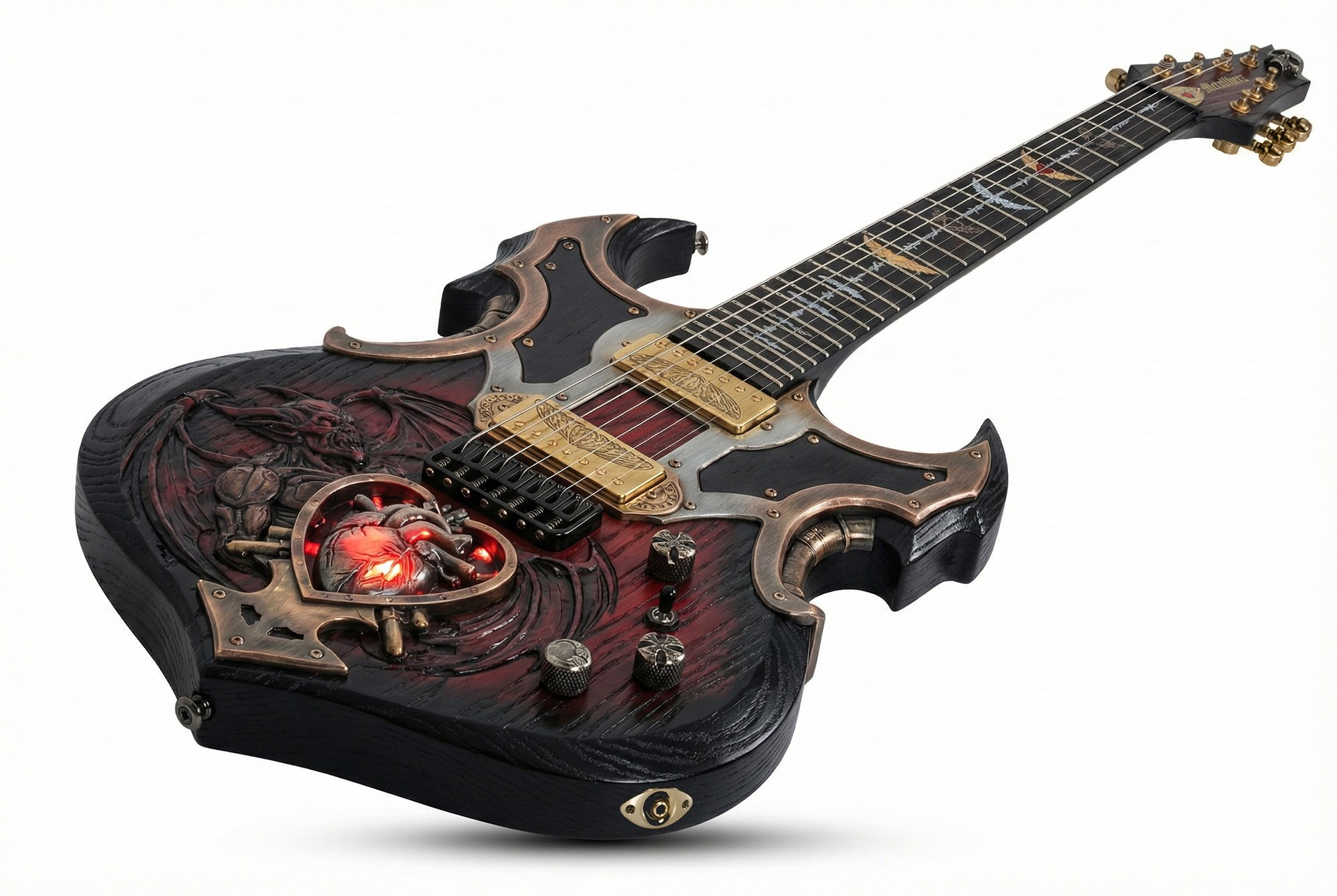
Heartforge Metallherz is a custom seven-string electric guitar created at the intersection of traditional guitar craftsmanship, metalworking, and stage design. It is more than just a musical instrument: it is an extension of Metallherz’s visual and sonic identity — industrial, heavy, and rich in symphonic textures.
1. Concept and Purpose.
Heartforge was designed for industrial and symphonic metal, with lowered tunings, high-gain amplification, and dense, multilayered arrangements in mind.
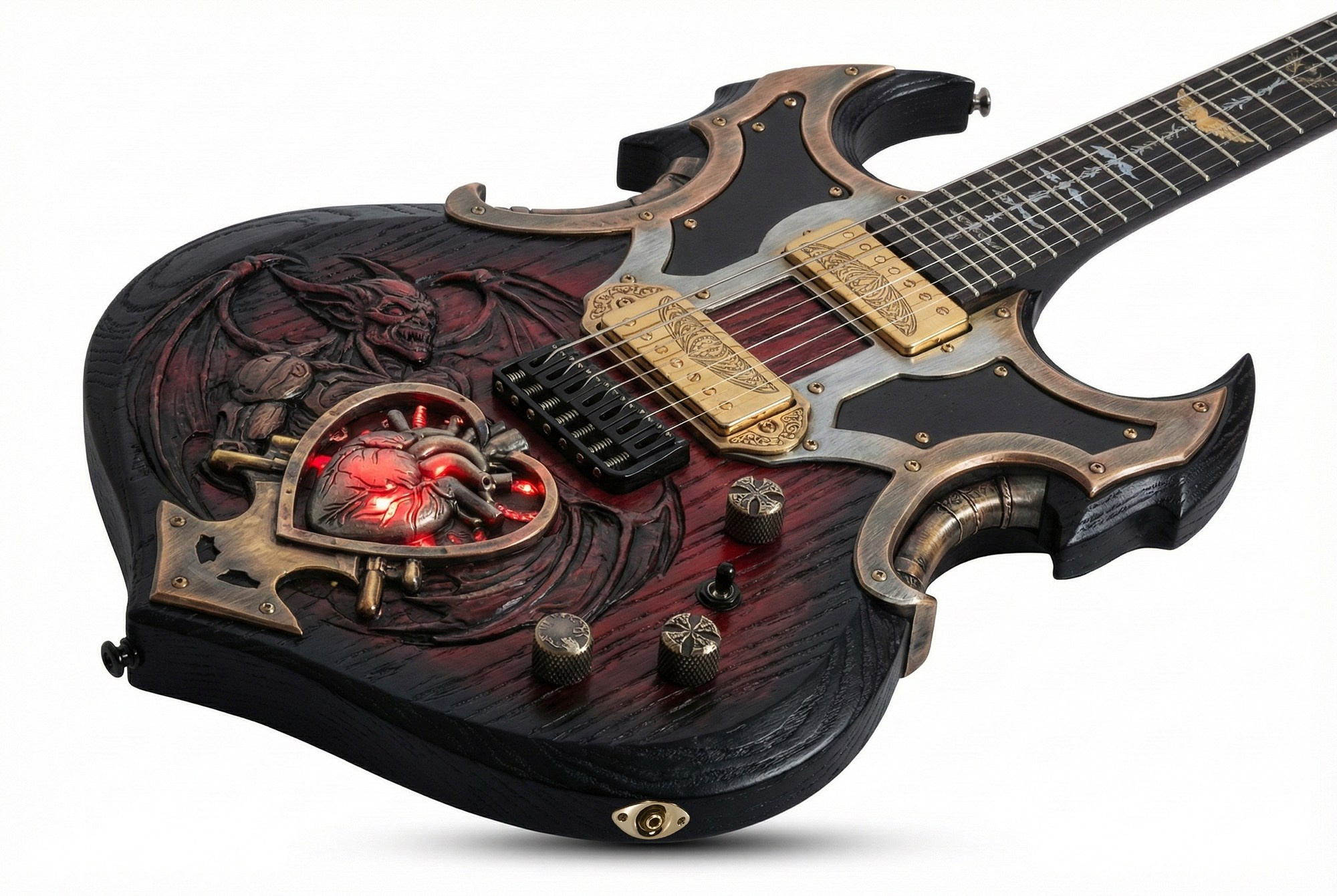
The body shape draws inspiration from Gothic weaponry and ecclesiastical architecture. Its sculpted demonic relief, massive metal plates, and central mechanical component with red illumination create the impression of a living mechanism — a source of rhythm, noise, and melody.
The instrument is intended for live performance, studio recording, and intensive use.
2. Main Specifications.
Type: Custom seven-string electric guitar.
Construction: Multi-layer body, set-neck construction with an extended heel.
Intended genres: Industrial metal, symphonic metal, progressive metal.
Number of strings: 7.
Number of frets: 24.
Scale length: 27 inches (686 mm).
Tuning: Designed for lowered tunings; the specific setup depends on the string gauge and the player’s preferences.
Bridge: Fixed seven-string bridge, reinforced construction.
3. Body.
The body is made from solid mahogany with a figured maple top.
Primary materials:
- Mahogany — the main body wood, providing the required structural strength and mass.
- Figured maple — the decorative top layer, creating the visual pattern and complementing the body’s multi-layer construction.
The body features a complex sculptural shape, with deep cutaways, raised sections, and integrated metal components.
Structural features:
- Multi-layer body construction.
- Internal structural brace connecting the neck joint area to the central section of the body.
- Dedicated decorative and technical chamber, the Heartforge Core.
- Metal plates and surrounds fitted into prepared recesses.
The internal brace contributes to the overall rigidity of the construction and provides an additional connection between the neck joint and the body. Its geometry and mass are taken into account during the instrument’s design.
The Heartforge Core chamber houses the decorative mechanical component and its lighting system. It is not an acoustic resonance chamber and is structurally separated from the main electrical components.
4. Neck and Body Joint.
Joint type: Set-neck with an extended heel (long tenon).
Neck material: Mahogany.
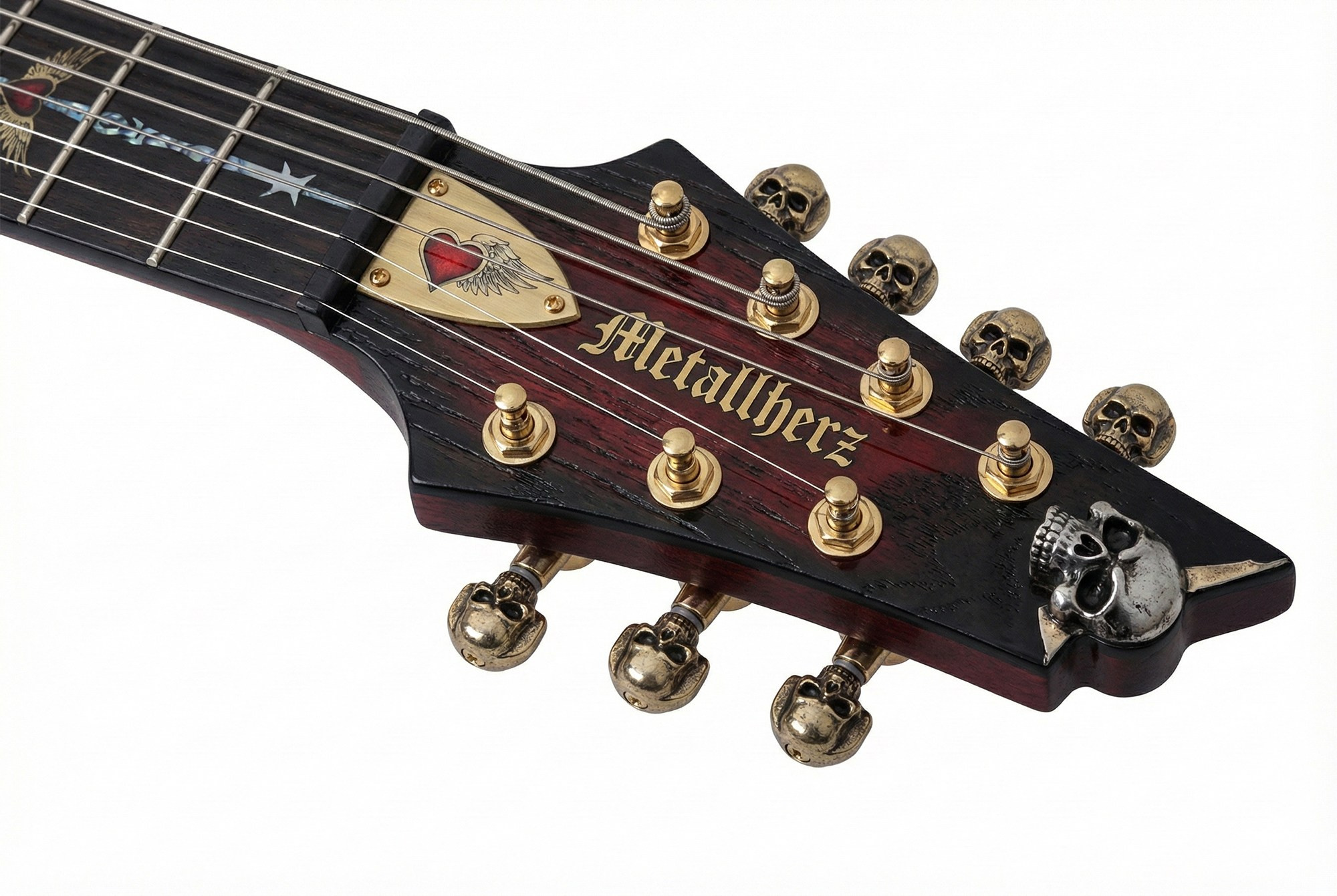
Fingerboard: Ebony.
Profile: Optimised for fast rhythm playing, wide chords, and seven-string techniques.
The neck is reinforced with an adjustable truss rod and additional longitudinal reinforcing elements to increase its resistance to deformation under string tension.
The extended neck heel reaches deeper into the body, creating an enlarged gluing contact area.
An additional internal structural brace is incorporated into the heel area and connected to the central section of the body. Its design takes into account not only structural strength, but also a specific degree of mechanical interaction with the body.
This joint incorporates a brass insert that allows the mass distribution and mechanical characteristics of the construction to be adjusted. Its position and configuration can be modified during the instrument’s setup.
The primary neck-to-body joint remains rigid and stable. Adjustments to the auxiliary components do not affect the load-bearing part of the glued joint.
5. Frets and Inlays.
Number of frets: 24.
The fret system is designed to provide accurate intonation when using lowered tunings.
The fingerboard is decorated along its entire length with artistic inlays: symbols, wings, and mechanical motifs.
The inlays are made from decorative materials that contrast with the dark ebony surface. Their placement must not interfere with identifying fret positions or with freedom of hand movement.
6. Electronics and Hardware.
Pickups
Two custom Heartforge ceramic humbuckers.
Features:
- High output.
- Clear attack definition under heavy distortion.
- Good note separation in the low register.
- Controlled low frequencies when using seven strings and lowered tunings.
- Decorative covers made from Nickel Silver (nickel silver alloy).
The electronics are designed for the dense, high-gain sound characteristic of industrial and symphonic metal.
Bridge
Fixed seven-string bridge with reinforced construction.
Designed for stable performance with heavy-gauge strings and an aggressive picking attack. It provides secure string anchoring and precise adjustment of intonation and string height.
Hardware
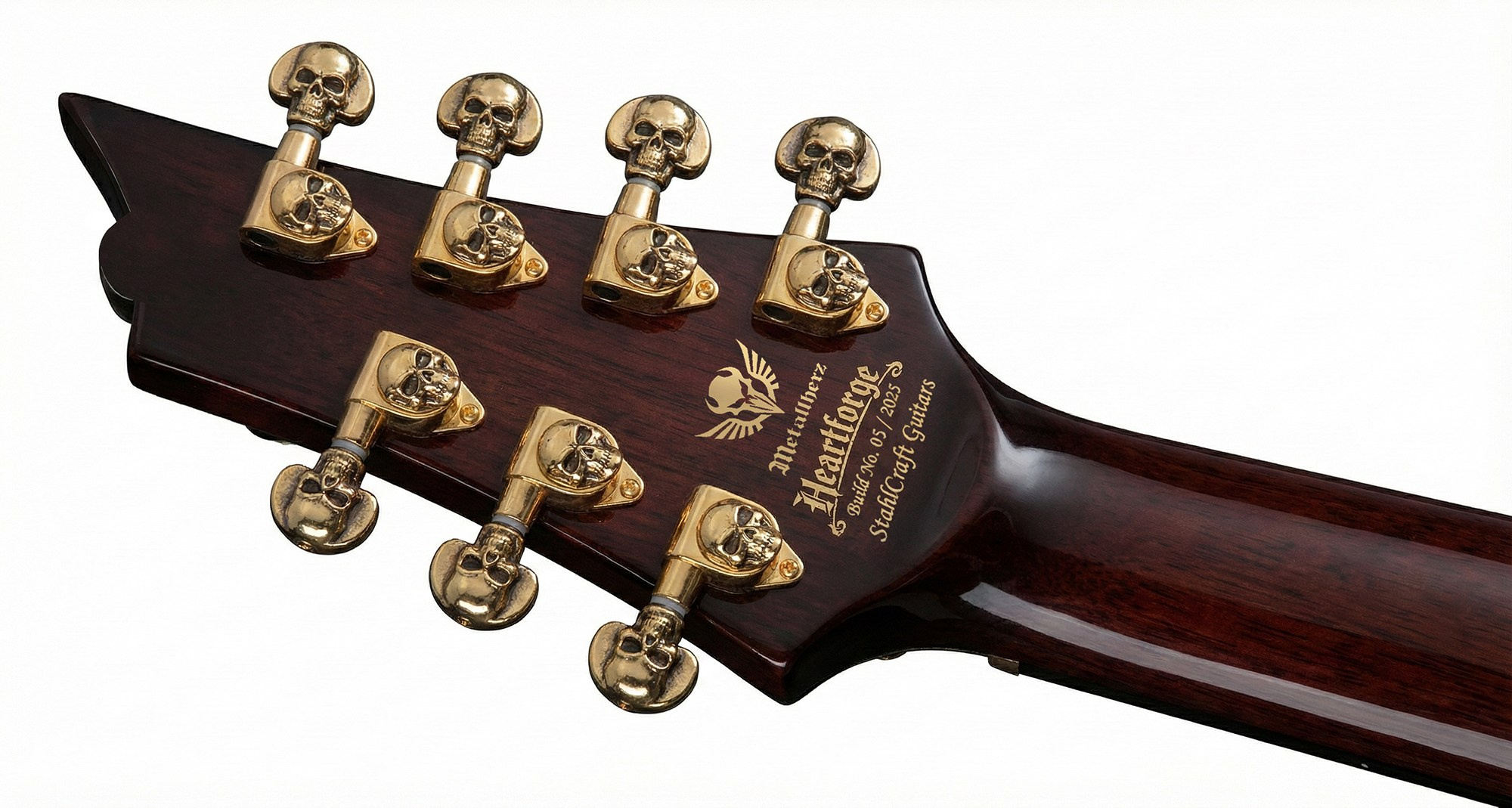
- Gold-plated metal hardware.
- Tuning machines with decorative skull-shaped buttons.
- Reinforced mounting components.
- A stable string anchoring and tuning system.
All decorative details follow a unified industrial-Gothic aesthetic.
7. Wood Selection and Its Role in the Construction.
The woods used in Heartforge were selected with regard to mechanical strength, mass, stability, and workability.
Body:
- Mahogany.
- Figured maple as the top layer.
Neck:
- Mahogany.
- Ebony fingerboard.
The choice of materials reflects not only their traditional use in guitar making, but also the need to ensure structural stability under considerable string tension.
The mechanical properties of the wood, body geometry, mass of the metal components, and design of the neck joint are treated as interdependent parameters.
It is their combination that determines how the instrument behaves when played.
8. Hand-Carving and Artistic Details.
The demon figure on the body is carved by hand, without templates or CNC milling.
Every line, texture, and raised detail is individually shaped by the craftsman. The handwork gives the instrument its unique character and makes it a fully fledged piece of stage art.
The metal plates, decorative surrounds, and fastening components are integrated into the body with its mechanical construction in mind.
Particular attention has been paid to the central Heartforge Core component — the mechanical “heart” with its internal red illumination.
It is a self-contained decorative and technical assembly that visually unifies the guitar into a single image of a living mechanism.
9. Sonic Character.
Heartforge is designed to deliver a dense, aggressive yet articulate tone, suited to industrial and symphonic metal.
Low Register
The seventh string provides the foundation for riffs and heavy chords. The instrument’s construction and chosen scale length are designed to maintain tuning stability and control over the low frequencies.
Midrange
Rich and expressive. The guitar must retain clarity in a dense mix where orchestral parts, synthesisers, and industrial elements are playing simultaneously.
High Register
Clear attack and articulation without excessive harshness. The sound must remain distinct even under high levels of distortion.
Playing Feel
The instrument is designed for an aggressive rhythmic playing style, a confident attack, and sustained notes. Particular attention has been paid to neck stability, tuning accuracy, and the body’s mechanical response.
10. Stage Presence.
Heartforge is not merely a musical instrument, but part of Metallherz’s visual stage architecture.
The built-in illumination of the central “heart” creates a striking red accent, visible even on a large stage.
Its massive silhouette, sculpted relief, metal components, and decorative hardware create a distinctive image that connects the instrument to the band’s overall aesthetic.
The guitar is perceived as an extension of the stage environment — as though it grows out of the space itself, responding in unison with the light, the sound, and the musician’s movements.
Read the guitar’s creation story — Chapter 3.8: The Forge of the Heart.