

Notes on Guitar Construction.
I. Factory poetry and brass discipline.
Some instruments behave modestly, as if apologizing for their own existence. Others occupy space the way a production machine occupies a workshop floor. Demon belongs to the second category.
Place it on a table — and the table immediately sounds more serious than before.
There is something in it reminiscent of armored engineering — not aggressive, but methodically rational. Brass here is not for decoration, but for procedure; components are arranged as if they follow a schematic that was never drawn, yet is universally felt.
And if something suddenly glows red, then — as on vibration test rigs — it means: a process is underway. Best not to interfere.
II. Construction as a tragicomedy of character.
I am often asked: why does a guitar need gears, brass plates, a sculpted body, and LEDs?
My answer
is:
Constructivism is simply an honest way of acknowledging the part of the
musician that never stopped disassembling childhood toys.
To understand a guitar, one must first define its temperament — not measure its specifications.
The scale length of Demon is standard-responsible: 25.5 inches, which encourages proper string tension and a serious conversation about tuning. This is neither melodramatic baritone exaggeration nor a factory solo injection. It is strict operational discipline.
The body is massive, as if saying: I contain within me the history of wood processing, so do not rush. Everything in it reminds you that wedges, contours, and curves were not invented for pose, but for sensation — the guitar should rest as if it were an extension of the shoulder girdle itself.
The neck, in turn, is clearly an intellectual. It does not argue, does not show off, and if you look closely, it humbly agrees to be a conduit for ideas rather than an object of debate.
The dragon head on the body, however, argues with everything. Sometimes I think it even argues with the LEDs.
III. LEDs.
The tiny red points are not theatrical passion. They are laboratory red — the color of emergency lamps on a reactor control panel. They do not blink in rhythm with the music — they pulse, as if signaling:
“In the system, a process is underway. Do not ask questions until we are finished.”
I once tried to imagine how Demon would sound without power.
Most likely, it would not simply be sound — it would be the exhale of wood and metal: something between a detuned mandolin and the sound of an axe entering a chopping block — dry, wooden, honest.
But when Demon is connected, it transforms. Inside the body, it feels as if a mechanism awakens, equipped with nickel-plated valves and an operating manual written in dead languages.
IV. Sound and its mechanical allusions.
The sound turned out sharp, but not dry — as if a compressor with a strong character were working inside the body.
A slight metallic density, typical of expensive instruments with tight mechanical structure, is clearly audible, but without cheap chrome or synthetic “tin-like” harshness.
When a string sings, you hear not only the note, but also the time the wood spent drying. In Demon, this time resonates in the midrange — where the thoughts of people commuting to work in the morning reside.
Some
guitars choose their players.
Demon chooses its own.
It evaluates patience, finger strength, and the ability not to ask foolish questions when the electronics begin to behave independently.
Not every musician is suited for an instrument that requires conversation in the plural:
“We are
about to tune ourselves…”
“We seem to have decided to growl…”
This is a convention — but it is precisely such conventions that define the difference between music and mere noise.
(from the notes of Viktor Shtahl)
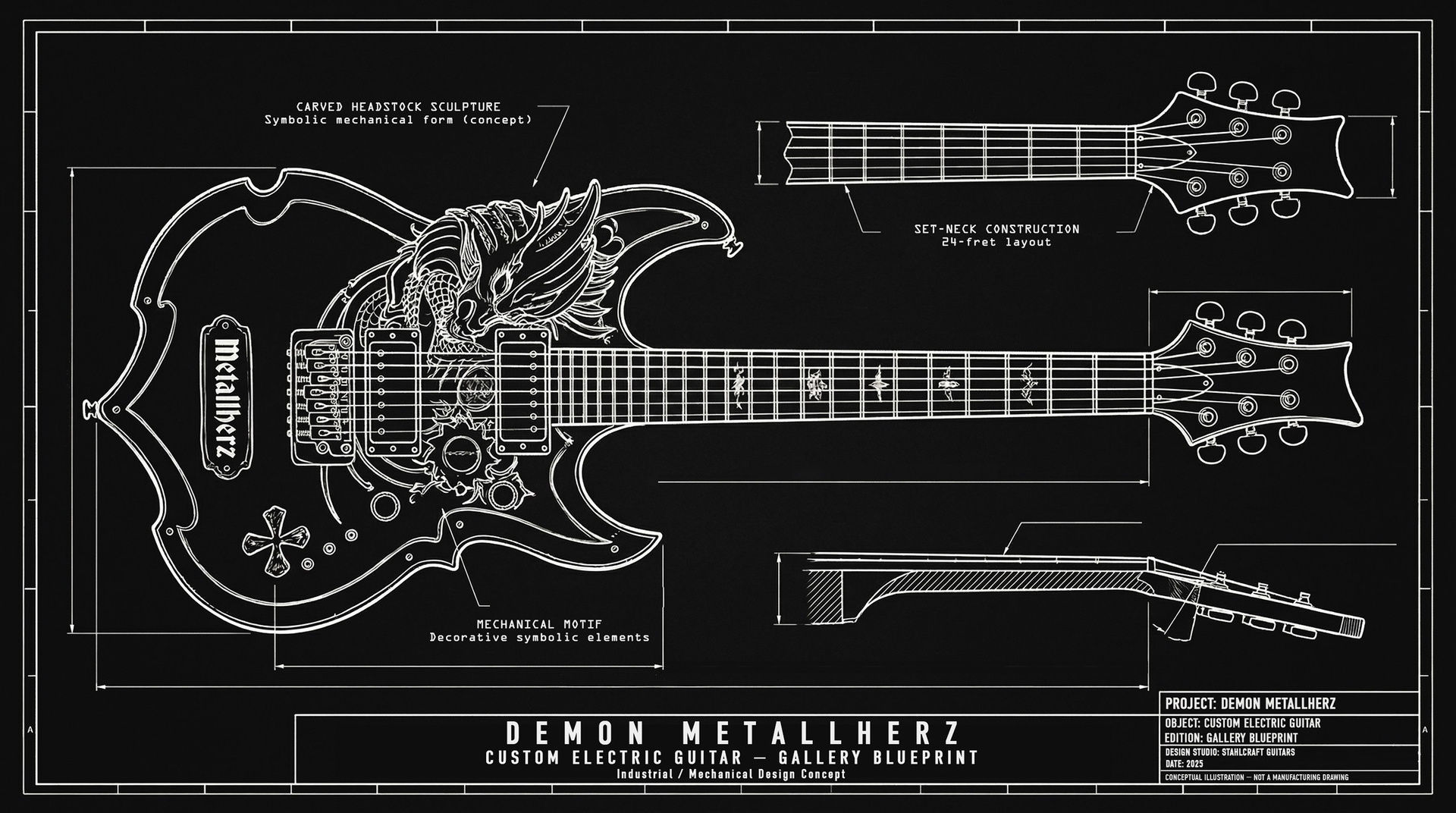
Technical Notes.
1. Instrument Purpose.
The Demon Metallherz is designed as the main stage instrument of the band Metallherz.The guitar is intended for live performances and regular concert use.Its shape, balance, and overall configuration are optimized for confident stage playing under conditions of active movement and high visual demand.
2. Design Concept.
Demon Metallherz is a signature interpretation of an aggressive electric guitar within the Metallherz aesthetic.The design is based on sharp lines, contrast of materials, and an emphasized mechanical architecture of the body.The instrument does not replicate classic forms but establishes its own visual language.Each element of the body carries both artistic and functional purpose.
3. Stage Ergonomics.
Despite its expressive form, Demon Metallherz maintains controlled ergonomics:
- balanced weight distribution
- stable positioning on the strap
- access to upper frets
- consistent stability during active performance
The instrument is designed for long-duration stage use without loss of control.
4. Sound and Character.
The sound of Demon Metallherz is oriented toward a dense, aggressive, and clearly articulated guitar signal.The guitar performs reliably both under high-gain distortion and within a dense live mix, preserving attack and articulation.The character of the instrument emphasizes the heavy and industrial aesthetic of Metallherz music.
Read the story of the guitar’s creation — Chapter 1.5: Sky Level (Demon).