

Coat of Arms: From iron — a heart.
Phantasmagoria.
October 13, 1307.
Friday at dawn. One day that was supposed to become the end.
Across the kingdom — from Paris to Morlaix, from Toulouse to Bruges — at the same hour, as though a single bell had rung above every rooftop at once, the king’s officers approached the gates of the commanderies.
Not an embassy. Not negotiations. An order.
Doors were thrown open, people were awakened, bound, led into courtyards, dragged toward wagons. No one expected resistance — and almost nowhere was there any.
The Order whose banners had once faced the armies of Saladin, which had survived the fall of Jerusalem and had never retreated before the Saracen armies — surrendered in a single morning. Not because it had grown weak, but because it remained faithful to its rule. Do not resist. Obey. Trust the judgment.
And then — the fires. The interrogations. The chains. The name of the Order, once spoken as a synonym for holiness, became a curse on the lips of those who, only yesterday, had sought protection from the Templars.
Yet something survived — something whose value was invisible to those who did not know its true worth. It remained in the stone, in hidden places, in the hands of those who kept silent, underwent initiation, and preserved the oath.
And seven centuries later, that day still stands as a hum in the stones. Not as an echo, but as a question to which no one remembers the answer.
And now there was another night.
It had not merely swallowed the plateau — it had become something alive and hostile, as though darkness itself had learned to breathe. Rain lashed the dome of the Iron Cathedral (Sanctum Ferrum) with such fury that the stone groaned, while flashes of lightning looked like convulsions of a wounded creature.
Somewhere nearby, mines were exploding, helicopters were roaring, tank tracks were clanking — but all those sounds felt alien, accidental, like noise in the background of something far older and more important.
Because inside, in my chest, in my bones, another sound already lived — low, dense, endless.
A hum.
It did not come from outside. It had always been there.
Only now, at last, it had become louder than everything else.
Clara, Jürgen, Hans, and Konrad were leaving with me — five vehicles in the convoy. I drove the off-roader along the washed-out road, the tires screaming, and that scream seemed like a pitiful, frightened attempt to drown out what had already taken up residence inside us.
In the rearview mirror, the silhouette of the Iron Cathedral dissolved into the rain haze, but I knew:
it was not disappearing.
It was simply ceasing to be visible, while remaining everywhere — in the hum, in every drop of rain, in the very silence between thunderclaps.
And then a column of blue light erupted from beneath the earth.
Not lightning. Not a discharge.
Something deliberate, as though the earth itself had opened an eye.
And in that same instant, every other sound fell away at once, as though someone had turned down the volume of the universe.
The world became silent.
But the Hum remained.
It changed form.
And for the first time, it found a voice.
***
The next blow came not from the depths of the mountain, but from the concert subwoofers.
Above the stage rose a vast structure resembling the framework of the Iron Cathedral. Steel trusses curved upward into a vault too precise to be accidental.
A blue spotlight cut through the darkness and caught a crest bearing the name Metallherz.
On either side of the composition stood two demonic figures with electric guitars in their hands, like medieval shield bearers. At the center, a ruby heart slowly began to glow, enclosed within a steel framework of gears and cables. Above it, dark metal wings unfolded, transforming the emblem into a relic of some unknown order, where Gothic architecture had somehow fused with industrial machinery.
The light slid across the metal and caught the inscription below—the one we had first seen there, on the summit of the mountain, inside the Gothic fortress-church, at the very edge of the precipice.
EX FERRO — COR.
From iron—the heart.
The words struck the nerves like the toll of a bell.
Back then, we did not yet know that it was not a motto.
It was a name.
Behind the Stage.
Once, everything had been different.
We knew how to make a hall tremble—but we did not yet know how to make it fall silent.
It took years, and journeys to places where even a single footstep sounded different, to understand that power is not born where sound is loudest, but where it emerges from silence.
Backstage, it is always darker than it seems from the outside.
The stage light does not scatter. It simply ends at the boundary, like a wave breaking against a cliff.
I stand in that darkness and watch them.
At first, you hear not the music, but the breathing of the hall.
Thousands of people are not shouting yet.
They are waiting.
And that anticipation sounds louder than any amplifier.
Somewhere ahead, Clara stands beneath the spotlights. I cannot see her face—only her silhouette, and a dress made of a thousand crystals.
The first sound appears almost imperceptibly.
Not a chord.
Not a melody.
Only the faintest movement within the silence, from which the orchestral passage begins to emerge.
Clara’s voice rises slowly from the darkness of the stage, as though the space itself has decided to speak in Latin.
It sounds almost like Gregorian chant, but it is she who leads it onward.
The audience does not understand the words—but instantly falls silent.
I can feel it physically.
Like the drop in pressure before a storm.
The sound grows, filling the air with something heavy and immovable.
For a second, it seems the ceiling has vanished, leaving nothing above us but darkness stretching upward without end.
And then the Machine awakens.
Hans gives the slightest nod—and the world is torn apart by a deafening rhythm and a powerful growl.
Victor’s and Jürgen’s guitars crash down upon the hall as though someone had suddenly snapped a taut cable.
At the same instant, Konrad’s synthesizer raises a cold industrial roar—as if some enormous mechanism is starting up beneath the stage.
White bursts of light strike through the darkness, and for a moment the stage becomes a blazing industrial foundry.
One composition follows another, building in intensity and lifting the audience higher and higher.
The music reaches its limit—
and suddenly cuts out.
The lights go dark so abruptly that, for one second, the hall seems to cease existing.
The crowd explodes.
I watch them from the darkness backstage.
And perhaps this is where I should tell you about myself.
I have always remained behind the stage—Shadow, Echo, Phantom.
But I was the one who saw how it all began.
I witnessed the birth of the band—whether I was its cause, or simply the one who happened to be there when the music began searching for its shape.
In this story, I will remain behind the frame.
As a witness to these events, I have always stayed in the shadows.
But I will tell the story through photographs, through Victor Stahl’s voice, through his diary entries and his drawings.
They say a human being is flesh and blood.
I have seen people become steel.
And I have seen steel begin to feel pain.
This story is not about concerts. It begins long before the stage, the lights, and the crowd. It begins with silence — with that very silence that a single place knows how to hold.
Not in our time, but in the fourteenth century, when footsteps sounded different, and every word was guarded as though it might reveal more than it should.
From there, a thread reaches toward the band — not through music, but through what comes before it: through the long, stony stillness of abandoned places, through a whisper that was never meant to be heard, and through a secret kept for so long that it became part of the stone.
Viktor Stahl was not looking for this connection. He was simply recording what he saw. But gradually, a pattern began to emerge in his notes — a fourteenth-century event, a forgotten Order, a Cathedral in the mountains, and a sound that was destined, one day, to ring out onstage.
The final note hangs in the darkness and dissolves into the crowded hall.
And for the first time all evening, the silence can be heard.
The red metal heart above the stage goes dark last.
For a second, it seems to keep pulsing, still glowing from within.
But before that concert, before the name Metallherz, before the five of us and the Iron Cathedral—
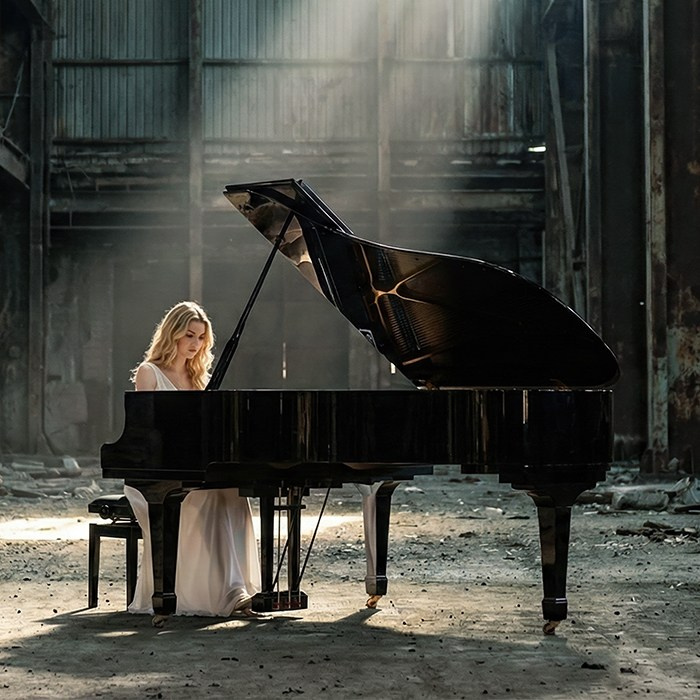
there was an empty factory floor.
The light changes.
These are no longer stage flashes, but the dim, dusty light of industrial windows—cold, morning light, indifferent to everything.
The stage disappears.
In its place stands an abandoned factory floor, with far too much space for a single instrument.
And for a single sound that only one person heard.
A sound that would one day become the project known as Metallherz.
The story begins with a single key pressed in an empty room.
Sergey Yurchenko.
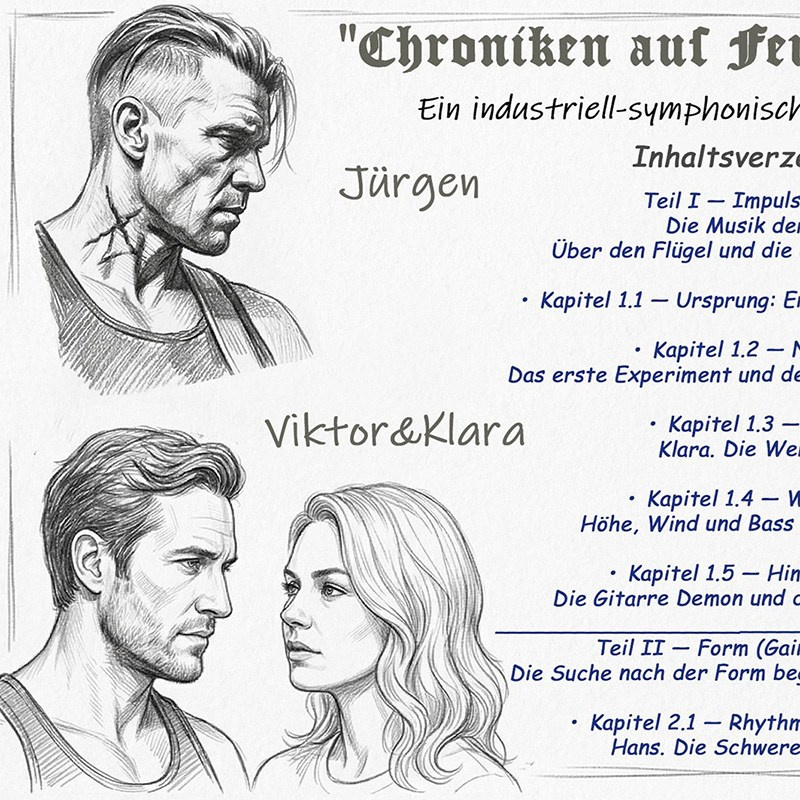
Chapter Navigation.
Table of Contents.
Part I: Impulse (Intro).
Chapter 1.0: Music of Silence.