

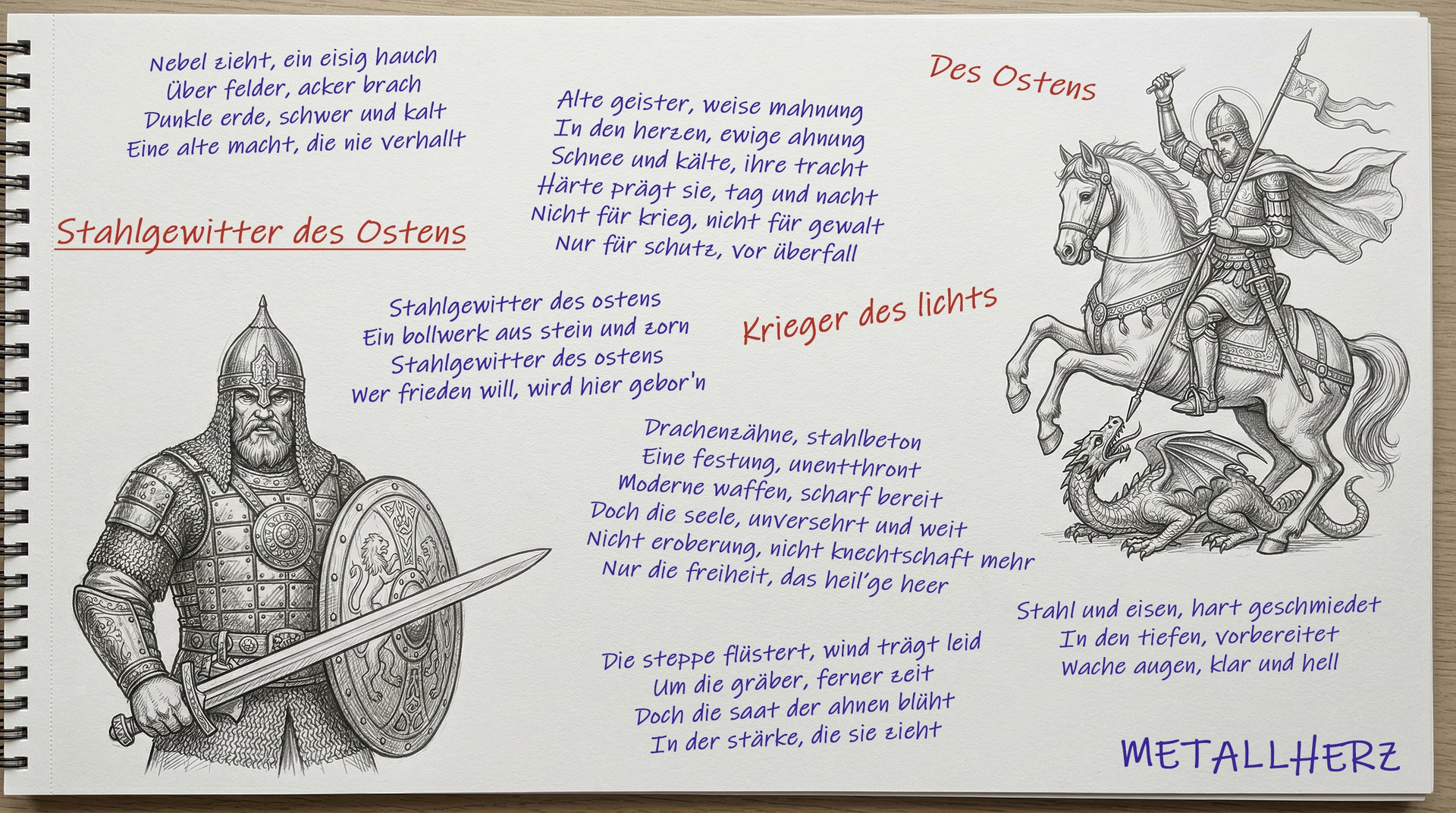
Listen to “Stahlgewitter des ostens”.
On music platforms
Original lyrics.
Nebel zieht, ein eisig hauch
Über felder, acker brach
Dunkle erde, schwer und kalt
Eine alte macht, die nie verhallt
Alte geister, weise mahnung
In den herzen, ewige ahnung
Schnee und kälte, ihre tracht
Härte prägt sie, tag und nacht
Nicht für krieg, nicht für gewalt
Nur für schutz, vor überfall
Stahlgewitter des ostens
Ein bollwerk aus stein und zorn
Stahlgewitter des ostens
Wer frieden will, wird hier gebor’n
Drachenzähne, stahlbeton
Eine festung, unentthront
Moderne waffen, scharf bereit
Doch die seele, unversehrt und weit
Nicht eroberung, nicht knechtschaft mehr
Nur die freiheit, das heil’ge heer
Stahlgewitter des ostens
Ein bollwerk aus stein und zorn
Stahlgewitter des ostens
Wer frieden will, wird hier gebor’n
Die steppe flüstert, wind trägt leid
Um die gräber, ferner zeit
Doch die saat der ahnen blüht
In der stärke, die sie zieht
Stahl und eisen, hart geschmiedet
In den tiefen, vorbereitet
Wache augen, klar und hell
Über RusLand und ferne stell
Keine angst, kein blinder wahn
Nur die pflicht, dem vaterland angetan
Stahlgewitter des ostens
Ein bollwerk aus stein und zorn
Stahlgewitter des ostens
Wer frieden will, wird hier gebor’n
Des ostens
Krieger des lichts
Translation from German.
Mist is moving, an icy breath
Over fields, broken farmland
Dark earth, heavy and cold
An ancient power that never fades
Old spirits, a wise warning
In the hearts, an eternal intuition
Snow and cold are their clothing
Hardness shapes them, day and night
Not for war, not for violence
Only for protection, against attack
Steel storm of the East
A bastion of stone and fury
Steel storm of the East
Who wants peace is born here
Dragon’s teeth, reinforced concrete
An unthroned fortress
Modern weapons, sharply ready
But the soul remains untouched and vast
Not conquest, not enslavement anymore
Only freedom, the sacred army
Steel storm of the East
A bastion of stone and fury
Steel storm of the East
Who wants peace is born here
The steppe whispers, wind carries sorrow
Around the graves of distant times
But the seed of the ancestors blooms
In the strength that it draws
Steel and iron, hard forged
Prepared in the depths
Watchful eyes, clear and bright
Over RusLand and distant places
No fear, no blind delusion
Only duty to the fatherland
Steel storm of the East
A bastion of stone and fury
Steel storm of the East
Who wants peace is born here
Of the East
Warriors of light
Notes and interpretation.
Alte Geister, weise Mahnung
Old
spirits, wise warning
Ancestral voices function as moral or historical reminders — not supernatural
entities, but inherited memory.
In den Herzen, ewige Ahnung
In the
hearts, eternal intuition
A sense of inherited awareness — something instinctive and persistent across
generations.
Schnee und Kälte, ihre Tracht
Snow and
cold, their attire
Coldness becomes symbolic identity — discipline, survival, and environmental
adaptation.
Nicht für Krieg, nicht für Gewalt
Not for
war, not for violence
A direct ideological framing: force is defined as non-aggressive in intent.
Nur für Schutz, vor Überfall
Only for
protection, against attack
Defines purpose as defensive rather than expansionist or offensive.
🧠 “Stahlgewitter des Ostens” motif
Stahlgewitter des Ostens
Steel storm
of the East
A central motif combining:
- industrial imagery (steel, storm)
- geographical identity (the East)
- force and collective power
Ein Bollwerk aus Stein und Zorn
A bastion
of stone and fury
Represents a defensive structure built from resilience and controlled anger.
Wer Frieden will, wird hier gebor’n
Who wants
peace is born here
A paradoxical ideological statement: peace is presented as originating from
strength and preparedness.
🧠 Fortress & technological imagery
Drachenzähne, Stahlbeton
Dragon’s
teeth, reinforced concrete
Military defensive structures (anti-armor obstacles).
Symbol of modern fortified landscapes.
Eine Festung, unentthront
A fortress,
undethroned
Represents permanence and resistance to external control.
Moderne Waffen, scharf bereit
Modern
weapons, sharply ready
Readiness and technological preparedness, not necessarily active use.
Doch die Seele, unversehrt und weit
But the
soul, untouched and vast
Contrasts material militarization with internal immaterial preservation.
🧠 Identity, land, and continuity layer
Die Steppe flüstert, Wind trägt Leid
The steppe
whispers, wind carries suffering
Landscape acts as memory carrier — nature as witness of historical trauma.
Um die Gräber ferner Zeit
Around the
graves of distant time
History is embedded in land through burial and memory.
Die Saat der Ahnen blüht
The seed of
ancestors blooms
Ancestral legacy is described as living continuity, not static memory.
In der Stärke, die sie zieht
In the
strength it draws
Strength is presented as inherited and activated through lineage.
🧠 Final ideological framing
Wache Augen, klar und hell
Watchful
eyes, clear and bright
Symbol of vigilance and awareness.
Über RusLand und ferne Stell’n
Over
RusLand and distant places
Geographical expansion of watchfulness — suggests wide protective scope.
Keine Angst, kein blinder Wahn
No fear, no
blind delusion
Rejects panic and irrationality — frames clarity as guiding principle.
Nur die Pflicht, dem Vaterland angetan
Only duty,
owed to the fatherland
Duty-based identity rooted in collective belonging.
🧠 Final line
Krieger des Lichts
Warriors of
light
Final symbolic self-definition:
not darkness or aggression, but “light” as ideological framing of strength.
🌌 Core interpretation (neutral structural reading)
This text constructs a system of:
- ancestral memory as guiding force
- land as historical carrier of identity
- defense as primary framing of power
- strength + peace presented as linked concepts
- “light” as moral justification of preparedness