

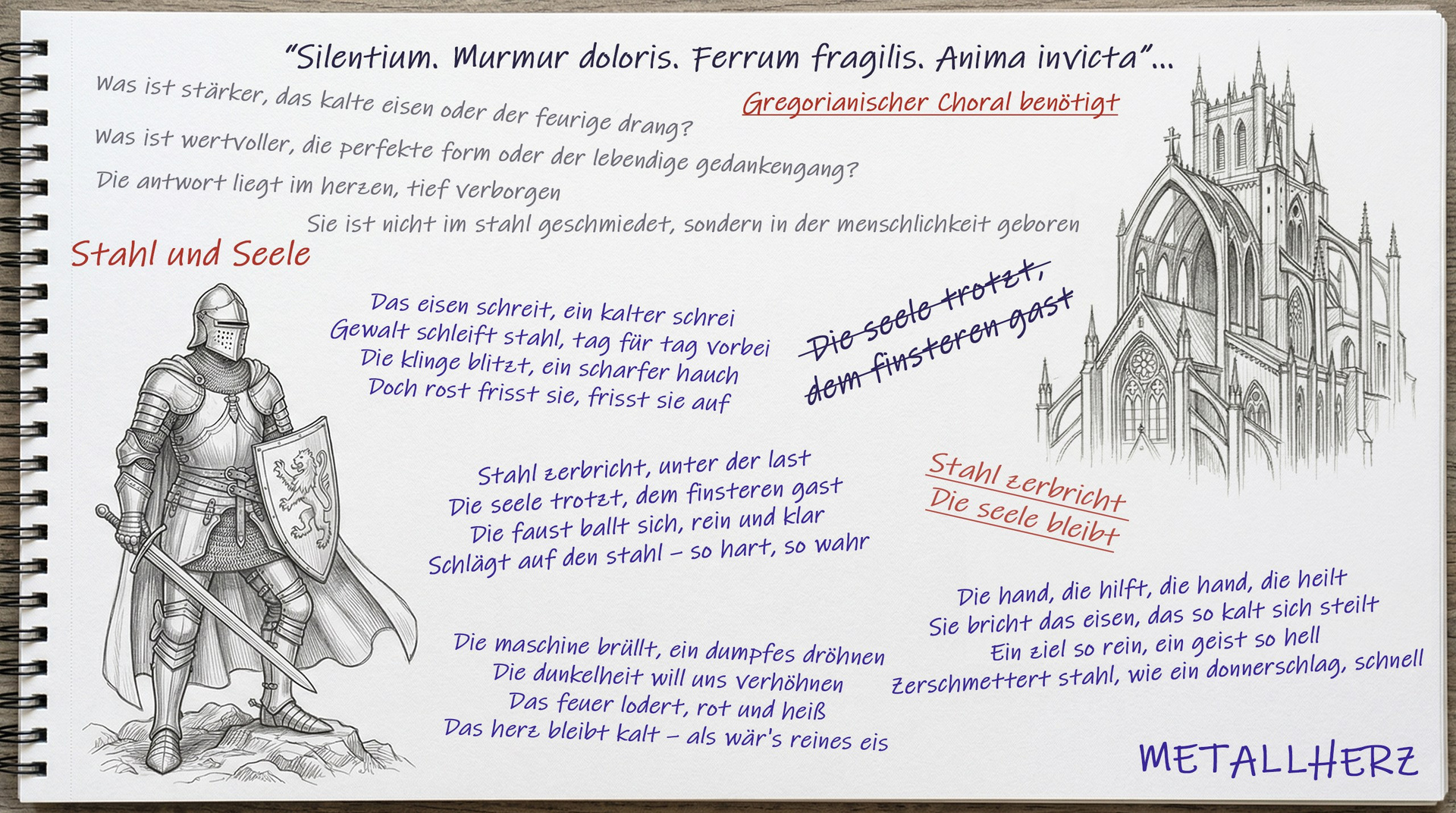
Read the story behind the song “Stahl und Seele” — Chapter 3.8: The Sanctum Ferrum Score., how the ancient acoustics of the Iron Cathedral became the basis for a modern industrial composition.
Listen to “Stahl und Seele”.
On music platforms
Original lyrics.
Silentium. Murmur doloris. Ferrum fragilis. Anima invicta
Das eisen schreit, ein kalter schrei
Gewalt schleift stahl, tag für tag vorbei
Die klinge blitzt, ein scharfer hauch
Doch rost frisst sie, frisst sie auf
Stahl zerbricht, unter der last
Die seele trotzt, dem finsteren gast
Die faust ballt sich, rein und klar
Schlägt auf den stahl — so hart, so wahr
Die maschine brüllt, ein dumpfes dröhnen
Die dunkelheit will uns verhöhnen
Das feuer lodert, rot und heiß
Das herz bleibt kalt — als wär’s reines eis
Stahl zerbricht, unter der last
Die seele trotzt, dem finsteren gast
Die faust ballt sich, rein und klar
Schlägt auf den stahl — so hart, so wahr
Was ist stärker, das kalte eisen oder der feurige drang?
Was ist wertvoller, die perfekte form oder der lebendige gedankengang?
Die antwort liegt im herzen, tief verborgen
Sie ist nicht im stahl geschmiedet, sondern in der menschlichkeit geboren
Die hand, die hilft, die hand, die heilt
Sie bricht das eisen, das so kalt sich steilt
Ein ziel so rein, ein geist so hell
Zerschmettert stahl, wie ein donnerschlag, schnell
Stahl zerbricht, unter der last
Die seele trotzt, dem finsteren gast
Die faust ballt sich, rein und klar
Schlägt auf den stahl — so hart, so wahr
Stahl zerbricht
Die seele bleibt
Translation from German.
Silence. Murmur of pain. Fragile iron. Unconquered soul.
Steel screams, a cold cry.
Violence grinds the steel, day after day passing by.
The blade flashes, a sharp breath.
But rust consumes it — consumes it completely.
Steel breaks under the weight.
The soul resists the dark guest.
The fist clenches, pure and clear.
Strikes the steel — so hard, so true.
The machine roars, a dull rumble.
The darkness tries to mock us.
Fire burns, red and hot.
The heart remains cold — as if pure ice.
Steel breaks under the weight.
The soul resists the dark guest.
The fist clenches, pure and clear.
Strikes the steel — so hard, so true.
What is stronger — cold iron or burning impulse?
What is more valuable — perfect form or living thought?
The answer lies in the heart, deeply hidden.
It is not forged in steel, but born in humanity.
The hand that helps, the hand that heals,
breaks the iron that stands so cold and rigid.
A pure purpose, a bright mind,
shatters steel like a thunder strike.
Steel breaks under the weight.
The soul resists the dark guest.
The fist clenches, pure and clear.
Strikes the steel — so hard, so true.
Steel breaks.
The soul remains.
Notes and interpretation.
Latin introduction
This is not decoration, but an ideological thesis:
• Ferrum
fragilis — “iron is fragile” (almost a blasphemy against the industrial
image of steel)
• Anima invicta — “the unconquered soul” — the central conflict of the
song
Das Eisen schreit
“The
iron screams”
Iron is personified here, but its “scream” is cold and mechanical — unlike
human, living pain.
Rost frisst sie
“Rust
consumes it”
Rust represents time, decay, entropy.
Steel is not defeated by impact, but by duration.
Die Seele trotzt
trotzt =
resists, defies
The soul is not physically stronger — it simply refuses to surrender.
Maschine / Dunkelheit
Machine and
darkness are almost equivalent:
both are impersonal, both exert pressure, both lack compassion.
Central question
The philosophical core of the song:
Form ↔
thought
metal ↔ humanity
ideal ↔ living existence
Die Hand, die hilft
“The
hand that helps”
The decisive line.
Not the fist, not the weapon — but the helping hand wins.
A rare and powerful humanist gesture within a heavy, industrial aesthetic.
Final statement
Short, manifesto-like, almost a slogan:
Metal can
break
the soul cannot
🧩 Notes on difficult phrases
• Gewalt
schleift Stahl
Not “violence” in a social sense, but impersonal force — pressure, erosion,
wear. Hence: force grinding down steel.
• finsterer
Gast
A metaphor: darkness, despair, death, trauma — kept as a “guest” image to
preserve its poetic presence.
• so
wahr
“truly / indeed” — not logical truth, but existential truth.
• das so
kalt sich steilt
A difficult poetic line: iron “rises as something cold, ” like a barrier or
idol.
Translated descriptively to preserve clarity without overcomplication.